
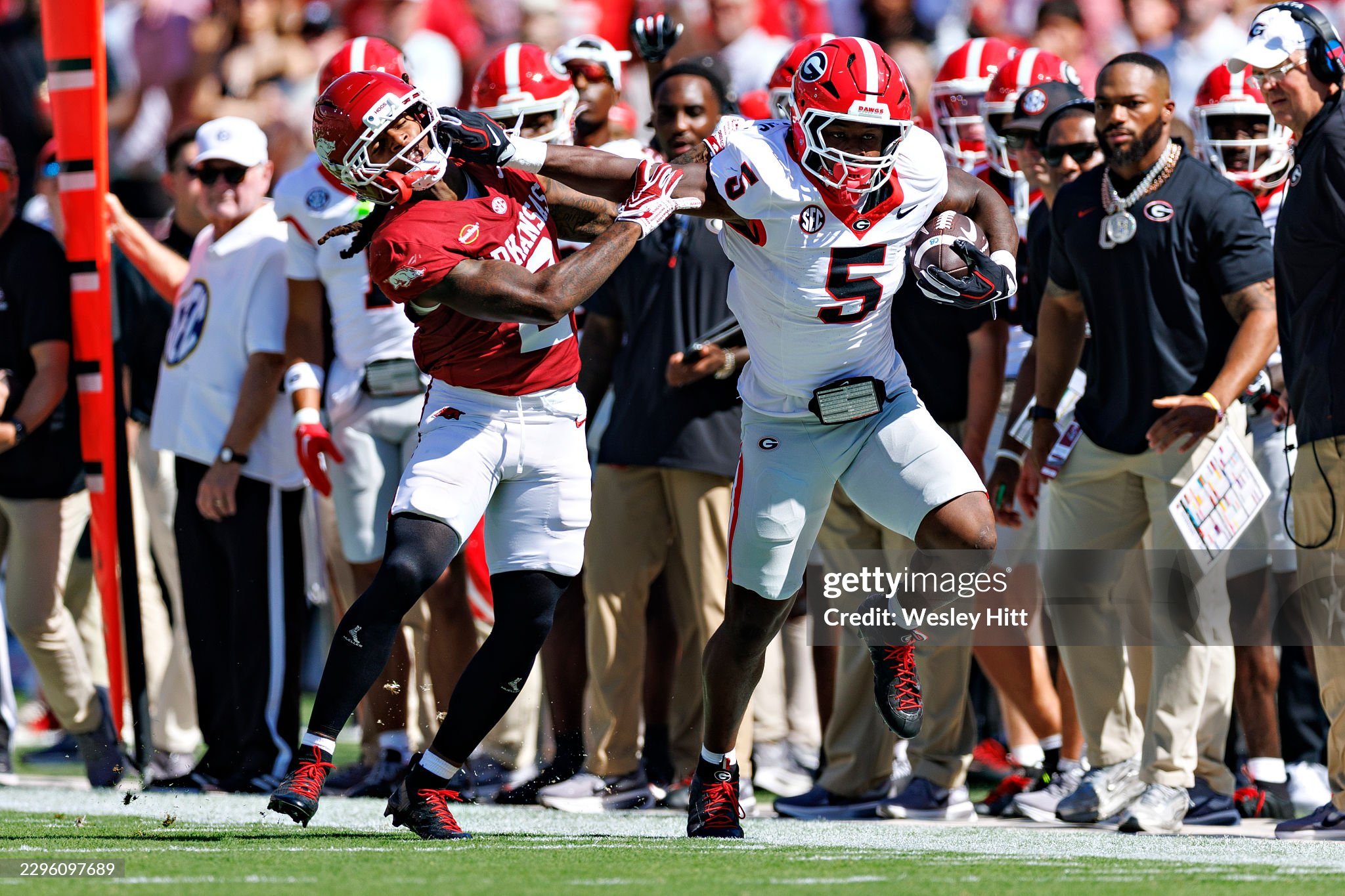
Another week of college football reshaped the Game Day Collective Top 25, but Texas held firm at No. 1.
But the GDC Top 25 is more than one person’s opinion.
Each week, Game Day Collective team members independently evaluate the college football landscape and submit their own Top 25 ballots. Our points-based voting system combines the ballots into one collaborative ranking that reflects the GDC team’s collective view.
The result is the official Game Day Collective Top 25.

How the GDC Top 25 Voting System Works
Rather than having one person determine where every team belongs, the GDC rankings combine individual ballots from across the GDC team.
Each ballot ranks the top 25 teams in college football from No. 1 through No. 25.
Points are then awarded based on placement:
- No. 1 receives 25 points.
- No. 2 receives 24 points
- No. 3 receives 23 points
- The scale continues downward.
- No. 25 receives 1 point.
- Teams left outside the Top 25 receive no points from that ballot.
We total the points from the GDC team’s ballots, and the 25 highest-scoring teams make up the official GDC Top 25.
This system lets different perspectives influence the final ranking without letting any single ballot determine the entire poll.
When teams finish with the same number of points, ballot placement breaks the tie, starting with the team that received the highest individual ranking.
As the season progresses, the rankings also become increasingly driven by what teams have actually accomplished on the field. Quality wins, losses, strength of opponent, game control, and overall performance all factor into how the GDC team evaluates its individual ballots each week.
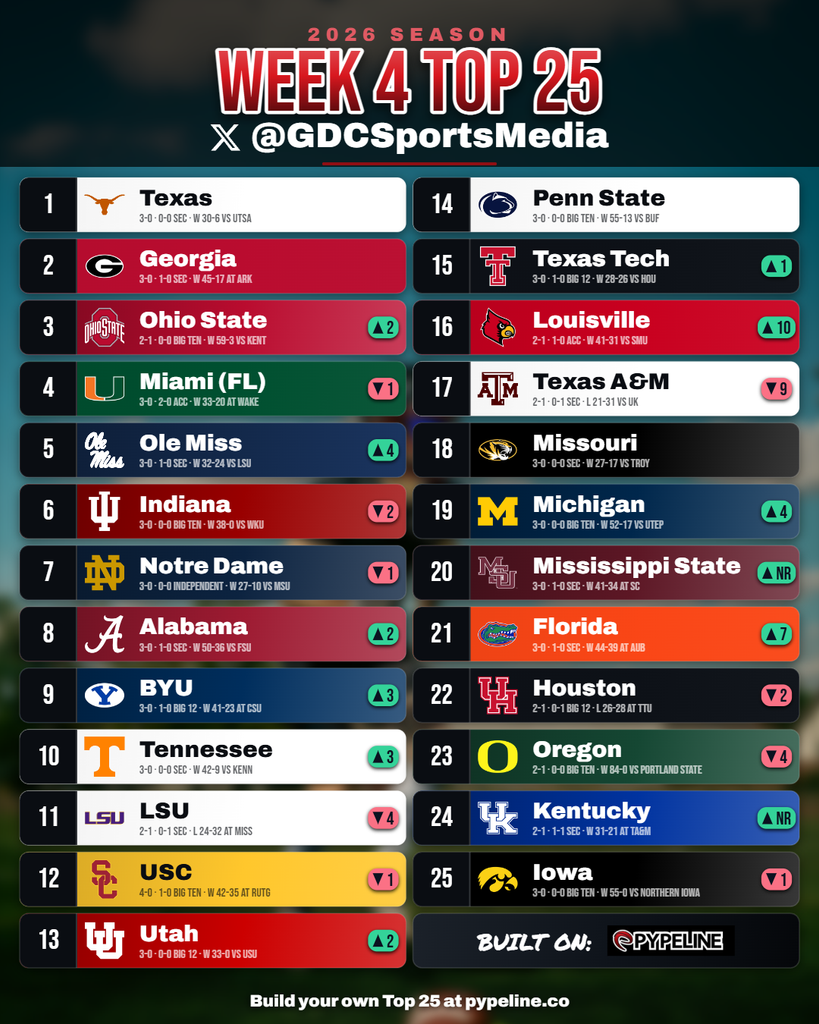
Official GDC Top 25 — Week 4
| Rank | Team | Points |
| 1 | Texas | 50 |
| 2 | Georgia | 46 |
| 3 | Ohio State | 45 |
| 4 | Miami | 44 |
| 5 | Ole Miss | 42 |
| 6 | Indiana | 42 |
| 7 | Notre Dame | 39 |
| 8 | Alabama | 36 |
| 9 | BYU | 32 |
| 10 | Tennessee | 31 |
| 11 | LSU | 30 |
| 12 | USC | 29 |
| 13 | Utah | 23 |
| 14 | Penn State | 22 |
| 15 | Texas Tech | 22 |
| 16 | Louisville | 19 |
| 17 | Texas A&M | 14 |
| 18 | Missouri | 14 |
| 19 | Michigan | 13 |
| 20 | Mississippi State | 11 |
| 21 | Florida | 11 |
| 22 | Houston | 11 |
| 23 | Oregon | 8 |
| 24 | Kentucky | 6 |
| 25 | Iowa | 4 |
Texas Remains the Unanimous No. 1
No one debated the top of this week’s GDC rankings.
Texas earned the maximum 50 points, making the Longhorns the clear No. 1 team in the Week 4 poll.
Georgia follows at No. 2 with 46 points, but the margin separating the next several teams is extremely small.
Ohio State sits just one point behind Georgia at No. 3 with 45 points, while Miami is another point back at No. 4 with 44.
That gives the GDC rankings an extremely tight group immediately behind Texas.
Ole Miss and Indiana Deadlocked
One of the most interesting results of the voting system comes at Nos. 5 and 6.
Ole Miss and Indiana each finished with 42 points.
Because Ole Miss received the higher placement on an individual GDC ballot, the Rebels win the tiebreaker and take No. 5, with Indiana immediately behind at No. 6.
That is exactly where the collaborative voting system becomes valuable.
When two teams receive nearly identical support, we separate them by weighing both their overall point totals and their placement across the individual ballots.
Alabama Leads the Next Group
Notre Dame checks in at No. 7 with 39 points, followed by Alabama at No. 8 with 36.
BYU enters the Top 10 at No. 9 with 32 points, while Tennessee rounds out the group at No. 10 with 31.
LSU narrowly misses the Top 10 at No. 11 with 30 points, followed closely by USC with 29.
The difference between No. 9 BYU and No. 12 USC is only three points, showing just how closely packed this portion of the rankings has become.
Penn State and Texas Tech Need a Tiebreaker
Another deadlock comes at Nos. 14 and 15.
Penn State and Texas Tech both finished with 22 points.
Penn State received the higher individual placement and therefore takes No. 14, while Texas Tech settles into No. 15.
Louisville follows at No. 16 with 19 points after producing one of the wider ranges of opinions across the GDC ballots.
Tight Competition Near the Bottom
The differences become even smaller deeper in the rankings.
Texas A&M and Missouri both received 14 points, with Texas A&M taking No. 17 through the tie-breaking procedure.
Mississippi State, Florida and Houston then all finished with 11 points.
Their final order — Mississippi State at No. 20, Florida at No. 21 and Houston at No. 22 — was determined by their highest placements across the GDC ballots.
Oregon lands at No. 23 despite not appearing on every GDC ballot, while Kentucky enters at No. 24 and Iowa claims the final position at No. 25.
Why the GDC Top 25 Is Different
The Game Day Collective Top 25 isn’t meant to recreate another national poll.
It’s to provide a collaborative GDC perspective on the college football season.
Different team members may value résumés, head-to-head results, dominant performances, quality losses, or overall team strength differently. Combining those opinions creates a ranking that reflects debate rather than eliminating it.
And as more games are played, preseason expectations matter less.
Every week gives us more evidence.
Teams can rise quickly by earning meaningful victories. They can fall when weaknesses start to show. And teams outside the rankings always have an opportunity to force their way into the conversation.
That’s what makes a weekly Top 25 interesting.
The rankings aren’t supposed to remain static.
They’re supposed to react to what happens on Saturdays.
And heading into Week 4, the GDC team agrees on at least one thing:
Texas is the team everyone else is chasing.
